Guide: How to Write an Analytical Report Using McKinsey Principles
1. The Main Idea
An analytical report is not a retelling of facts. Its purpose is to help a manager, client, or investor make a decision.
That is why the report must answer three questions:
- What is happening?
- What does it mean?
- What should be done?
The main principle:
Start with the conclusion. Then explain. Then provide evidence.
This is called Lead with the answer.
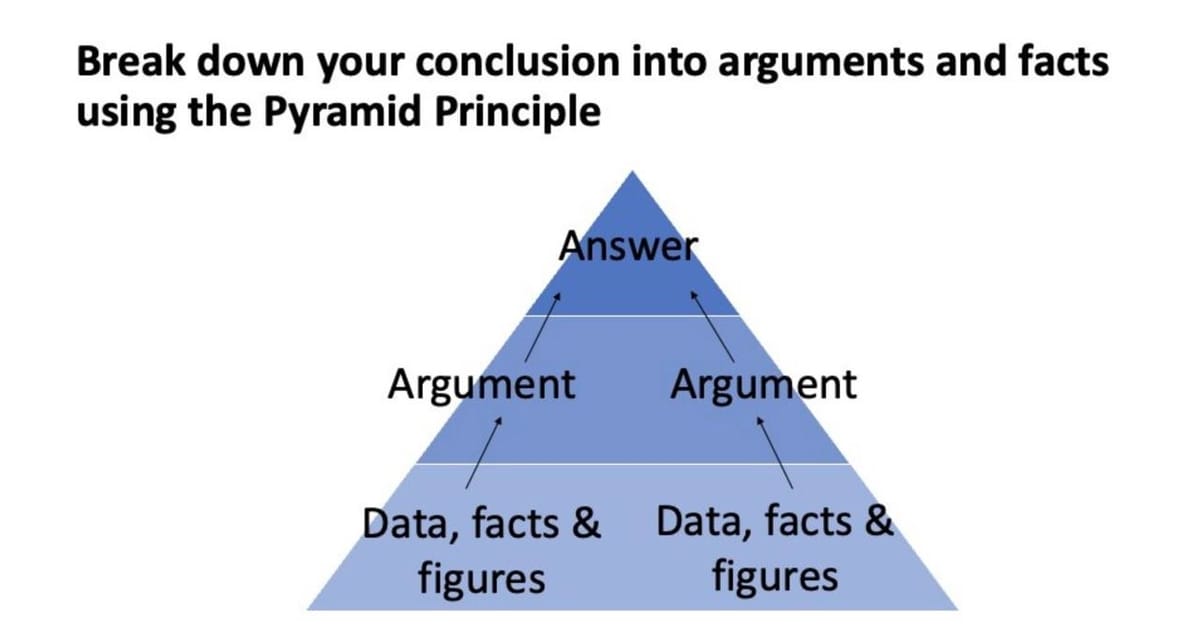
The second principle is the Pyramid Principle: the entire argument is built as a pyramid.
At the top is the main conclusion.
Below it are 3–5 key arguments.
Further below are facts, figures, examples, and calculations that prove each argument.
2. What Is Wrong with a Typical Report
An inexperienced employee often writes like this:
“We studied the market. First, we looked at competitors. Then we analyzed prices. Then we spoke with clients. Then we collected advertising data. As a result, it can be said that there are certain opportunities for growth.”
The problem: the reader spends too much time trying to understand where the text is going.
In McKinsey style, it should be written like this:
“The company should enter Market X within the next 6 months because demand has already formed, competition is fragmented, and the project economics allow payback within 12–15 months.”
After that, you can explain the details.
3. Basic Structure of an Analytical Report
A good report usually consists of 7 parts:
- Executive summary — a brief main conclusion.
- Context and question — what problem we are solving.
- Main answer — what we recommend or claim.
- Logic of the argument — why this is true.
- Evidence — data, calculations, facts, comparisons.
- Risks and limitations — what may go wrong.
- Recommendations and next steps — what to do next.
4. Executive Summary: How to Write the Main Conclusion
An executive summary is a short 5–10 line summary. It should be understandable even to someone who will not read the entire document.
Formula:
We recommend / believe that [main conclusion] because [argument 1], [argument 2], [argument 3]. To implement this, it is necessary to [key actions]. The main risks are [risks], but they can be reduced through [mitigation measures].
Example:
We recommend launching an MVP of a review platform for the travel market within 3 months. The opportunity is attractive because most competitors in the local market do not verify reviews, users are not confident that existing tools limit bots from travel agencies, and the business model can be monetized through lead generation and premium placement. At the first stage, it is important to have an effective filter for authorized users, and only after that to build traffic, reviews, and a company database. The main risks are low user engagement and weak activity from travel agencies; they can be reduced through newsworthy content, SEO content, and transparent publication rules.
5. The Lead with the Answer Principle
What It Means
You do not need to begin with a long description of the research process. Start with the answer.
Bad:
“As part of the analysis, we studied 25 companies, reviewed prices, compared traffic, and conducted interviews. The results are presented below.”
Good:
“The market is attractive for entry, but only through a niche MVP: a full-scale launch with broad functionality would create unnecessary costs and would not increase the chances of success.”
Why It Works
A manager does not read a report for the sake of the process. They need to quickly understand:
– what decision is being proposed;
– why it is reasonable;
– what the risks are;
– what should be done next.
That is why the first screen, first page, or first slide must immediately communicate the meaning.
6. Pyramid Principle: How to Build a Pyramid of Arguments
The pyramid looks like this:
Main Conclusion
The company should launch Product X as an MVP within 3 months.
Second-Level Arguments
- There is unmet demand in the market.
- Competitors do not address the client’s key pain point.
- The MVP can be launched quickly and cheaply.
- The project economics have payback potential.
Third-Level Evidence:
Each argument needs supporting facts.
1. There Is Unmet Demand
– users search for information on Google;
– there are complaints on social media;
– current solutions do not inspire trust;
– interviews confirm the problem.
2. Competitors Do Not Address the Pain Point
– data is fragmented;
– reviews are difficult to verify;
– there is no comparison of companies.
3. The MVP Can Be Launched Quickly
– basic catalog;
– review form;
– moderation;
– SEO pages;
– traffic analytics.
4. There Is Economic Potential
– monetization through leads;
– paid placement;
– advertising formats;
– partner commissions.
7. The Rule of 3–5 Arguments
You do not need to give 12 reasons. A good report usually rests on 3–5 strong arguments.
Optimal structure:
Main conclusion
→ 3 key arguments
→ 2–4 pieces of evidence for each argument
Example:
We recommend not launching the full product immediately, but starting with an MVP.
Why?
- The full product will increase timelines and costs.
- The main value lies in the ability to build trust.
- The MVP will allow demand to be tested before large investments.
8. The MECE Principle
MECE means:
Mutually Exclusive, Collectively Exhaustive.
In other words:
The points do not overlap, and together they fully cover the issue.
This means that arguments should not duplicate each other, but together they should cover the entire question.
Bad:
- We have few clients.
- We have weak sales.
- We have few leads.
These points overlap.
Better:
- The problem is lead generation.
- The problem is conversion of leads into sales.
- The problem is customer retention after the first purchase.
This structure is cleaner: each block is responsible for a separate part of the problem.
9. How to Write Headings
In an analytical report, a heading should not simply name the topic. It should communicate the conclusion.
Bad:
Market Analysis
Good:
The Market Is Growing, but Entry Should Be Through a Narrow Niche
Bad:
Competitors
Good:
Competitors Are Strong in Distribution but Weak in Personalized Service
Bad:
Financial Model
Good:
The Project Can Reach Operating Break-Even with 300–400 Paying Clients
If you read only the headings, they should form a logical storyline of the report.
10. Structure of a Page or Slide
Each page should answer one question and prove one idea.
Page formula:
1. Conclusion Heading
For example:
The main problem is not the product price, but lack of trust in the supplier.
2. Brief Explanation
2–4 lines explaining the logic.
3. Evidence
Figures, table, chart, examples, client quotes, comparison.
4. Decision Implication
What this means for the business.
Example:
If the barrier is trust, discounts will not solve the problem. The company needs to strengthen case studies, guarantees, reviews, and process transparency.
11. How to Write Arguments
A good argument consists of three parts:
- Claim — what we believe.
- Evidence — why it is true.
- Implication — what follows from it.
Example:
Claim: launching the full product now is premature.
Evidence: the key hypothesis — the existence of demand — has not yet been confirmed through real reviews and organic traffic.
Implication: first, the company should launch an MVP, collect user behavior data, and only then invest in complex functionality.
12. How to Work with Data
Data should not merely be present. It should prove the conclusion.
Bad:
The table below presents market indicators for the past 5 years.
Good:
Data from the past 5 years shows that the market is growing unevenly: two segments drive most of the growth, so the launch should focus specifically on them.
Every number must answer the question:
Why is this number needed for the decision?
If a number does not help make a decision, it is better to remove it or move it to the appendix.
13. Typical Forms of an Analytical Report
Option 1. Report for a “Launch or Do Not Launch” Decision
Structure:
- Main recommendation.
- Why the question matters now.
- Size of the opportunity.
- Client pain point.
- Competitive situation.
- Project economics.
- Risks.
- Recommendation and launch plan.
Option 2. Report for Diagnosing a Problem
Structure:
- Main diagnosis.
- Symptoms of the problem.
- Root causes.
- Evidence for each cause.
- Consequences of inaction.
- Possible solutions.
- Recommended solution.
- Implementation plan.
Option 3. Report for Growth Strategy
Structure:
- Main growth direction.
- Current position of the company.
- Where the opportunities are.
- Which opportunities are most attractive.
- What should be done first.
- What resources are needed.
- What the risks are.
- Roadmap.
Option 4. Report for an Investor
Structure:
- Investment thesis.
- Market problem.
- Solution.
- Market size.
- Business model.
- Competitive advantage.
- Financial logic.
- Team and plan.
- Risks.
- Requested decision.
14. Universal Report Template
Title
Briefly state what the report is about and what decision needs to be made.
1. Executive Summary
A brief answer to the entire question.
Formula:
We believe that [conclusion]. This is based on [3 arguments]. Therefore, we recommend [action]. The main risks are [risks], but they are manageable through [measures].
2. Context
What is happening? Why has the question arisen now?
You need to explain:
– the situation;
– the problem;
– the purpose of the analysis;
– who the decision is being prepared for.
3. Key Question
This is formulated as a management question.
Examples:
– Should we launch the product?
– Why are sales falling?
– Which market should we enter first?
– Which acquisition channel should we scale?
– How can operational risks be reduced?
4. Main Answer
One clear thesis.
Example:
The company should launch the product, but only as an MVP and only in one segment, because a broad launch would create high costs before demand is confirmed.
5. Arguments
Usually 3–5 arguments.
Example:
- Demand exists, but it is concentrated in a narrow segment.
- Competitors do not address the key pain point.
- The MVP allows the hypothesis to be tested at low cost.
- A full launch now carries a high risk of budget overruns.
6. Evidence
For each argument:
– data;
– calculations;
– interviews;
– comparisons;
– market facts;
– internal metrics;
– client examples.
7. Risks and Limitations
You need to honestly state:
– where the data is incomplete;
– what assumptions were used;
– what could change the conclusion;
– which risks are most dangerous.
8. Recommendations
What exactly should be done?
Recommendations must be practical:
– who does it;
– what they do;
– by when;
– what result is expected.
9. Next Steps
Example:
- Within 2 weeks, validate demand through interviews and a landing page.
- Within 4 weeks, build the MVP.
- Within 8 weeks, launch SEO content and review collection.
- After 12 weeks, decide whether to scale.
15. How to Prepare the Report: Work Process
Step 1. Formulate the Question
Bad question:
Analyze the market.
Good question:
Should the company enter Market X in 2026, and if so, with what product and budget?
Step 2. Formulate a Preliminary Answer
Even before the full analysis, you need a hypothesis.
Example:
It is likely worth entering the market, but through an MVP, because the market is interesting but demand has not yet been confirmed.
The hypothesis may change after the analysis. That is normal.
Step 3. Break the Question into Blocks
Example for a product launch:
- Does the client have a problem?
- Is the client willing to pay?
- Who are the competitors?
- Can we build the product?
- Do the economics work?
- What are the risks?
Step 4. Collect Data
Data is not collected “in general,” but for the specific blocks of the pyramid.
Step 5. Check the Logic
Ask yourself:
– Is the main conclusion clear from the first page?
– Do the arguments avoid duplication?
– Is each argument proven?
– Are there weak points?
– Do the recommendations follow from the analysis?
Step 6. Write the Report
Writing order:
– First, the structure.
– Then, the key theses.
– Then, the evidence.
– Then, the executive summary.
– Then, final editing.
The executive summary is often best written at the end, once the full logic is clear.
16. Practical Example
Suppose the question is:
Should the company launch a Telegram channel for a B2B audience?
Bad structure:
- What Telegram is.
- Telegram statistics.
- Examples of channels.
- Content plan.
- Conclusions.
Good structure:
Main Conclusion
The company should launch a Telegram channel if it is ready to use it not as a news feed, but as a tool for trust-building and lead generation in a narrow B2B niche.
Argument 1
A B2B audience makes decisions slowly, so the channel must regularly build trust.
Evidence:
– long sales cycle;
– high importance of expertise;
– importance of repeated touchpoints.
Argument 2
Monetization will depend not on the number of subscribers, but on the quality of the audience.
Evidence:
– one qualified lead can be more valuable than thousands of random views;
– job titles, industries, and purchasing power of the audience matter.
Argument 3
Content should be built around client problems, not company news.
Evidence:
– people read what helps them solve tasks;
– expert content reduces distrust;
– case studies and breakdowns create practical value.
Recommendation
Launch the channel as a 3-month pilot: 3 posts per week, focus on client pain points, monthly evaluation of leads, engagement, and audience quality.
17. Common Mistakes
Mistake 1. Starting with the Research Story
You do not need to explain in detail how you worked. Show the conclusion.
Mistake 2. Giving Many Facts Without Meaning
Facts without interpretation do not help make a decision.
Mistake 3. Hiding the Recommendation at the End
The manager should understand the recommendation immediately.
Mistake 4. Making Headings Too Generic
A heading should be a conclusion, not the name of a section.
Mistake 5. Mixing Different Levels of Logic
You cannot place a strategic conclusion next to a minor operational detail.
Bad:
- We need to enter the Brazilian market.
- We need to change the color of the button on the website.
- We need to hire a director.
Better:
- Entry into the Brazilian market is attractive.
- To enter, the company needs local sales, payment infrastructure, and legal adaptation.
- Among operational tasks, the first priority is hiring a local director.
Mistake 6. Not Showing Risks
A report without risks looks like advertising, not analysis.
Mistake 7. Giving Recommendations Without an Owner and Deadline
Bad:
Improve marketing.
Good:
Within 30 days, test 3 acquisition channels: SEO, Telegram Ads, and partner publications. Owner — marketing. Success criterion — cost per qualified lead below X.
18. Checklist Before Submitting the Report
Before sending the report, check:
- The main conclusion is clear on the first page.
- The report answers a specific management question.
- There are 3–5 main arguments.
- The arguments do not duplicate each other.
- Each argument is supported by data or logic.
- Page headings are formulated as conclusions.
- There are no unnecessary facts that do not help the decision.
- Risks and limitations are stated.
- Recommendations are specific.
- It is clear what to do next, who is responsible, and by when.
19. Mini-Template for an Employee
Before writing the report, fill out this form.
1. What question are we solving?
…
2. Who will make the decision?
…
3. What is the main conclusion?
…
4. What 3–5 arguments support the conclusion?
- …
- …
- …
- …
5. What evidence exists for each argument?
Argument 1:
– …
– …
Argument 2:
– …
– …
Argument 3:
– …
– …
6. What are the risks and limitations?
– …
– …
7. What do we recommend doing?
– …
– …
8. What are the next steps?
- …
- …
- …
20. The Main Rule
A good analytical report is not a long text or a set of beautiful tables.
A good analytical report is clear logic that leads the reader from the question to the decision.
Final formula:
Answer → Arguments → Evidence → Risks → Actions.
If an employee follows this formula, their report will be clear, persuasive, and useful for decision-making.
Weekly high-risk digest
Regulation, sanctions and payment news across your verticals — once a week, free.
Please check your inbox and click the link to confirm your subscription.
Please enter a valid email address!
Comments